Riley Balsawood Surfboards
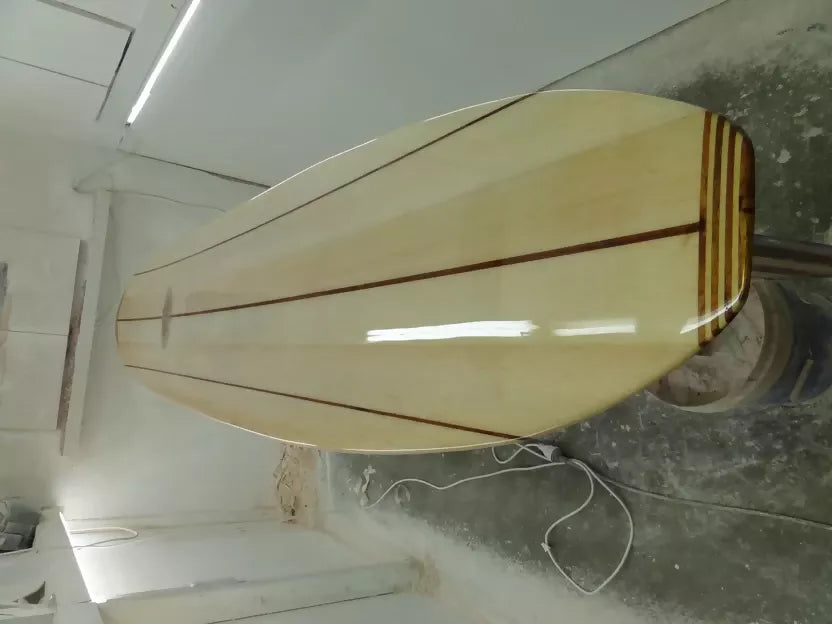
Solid Balsa Classic Malibu
Solid Balsa Classic Malibu
Enter your quote details
• 12 month warranty - you snap it - we replace it
• The Classic weighs around 15 kg– like the boards back then
• The strongest and most durable longboard available
• triple cedar stringer
• proven shape
• Hand shaped and glassed in Australia - quality guaranteed
• Great resale value
These come with a triple stringer and a set glassed on D or Pixi fin - customs are available - Extra $100 per stringer - NOTE - if this is ordered through EBAY the fin is not included because of the size and its fixed.
Passion, love and skill Review by Tom - The 12'6" Balsa board you made for me is just great, it looks like a work of art and rides good as well! Its easy to see the passion, love & skill that you put into very board you make.
Yours in surfing
Tom Fordyce
PS Still love the 9'2" you made me.
After World War 2 the first balsawood surfboards emerged and changed surfing dramatically. These lighter and more manoeuvrable boards meant a more radical surfing style which soon became known as hot-dogging. From their origin in Malibu, California, balsa surfboards soon made their way to Australia were keen surfers such as Scott Dillon began riding and making them. The Riley Classic is a solid Malibu inspired by these boards of the 50’s and 60’s which the Australians, Americans and Hawaiians rode at the small point breaks of Noosa, Malibu and Waikiki. This is a great board for hot-dogging and reminiscing those good ol’ days. The Classic should definitely be ridden but nonetheless it looks great on office walls, restaurants, homes and shops, creating a heritage look. Own a part of surfing history!
Longboards are the original and very first variety of board used in standup surfing. Ever since the sixth-century CE the ancient Hawaiians have used 8-to-30-foot (2.4 to 9.1 m) solid wooden boards when practicing their ancient art of Hoe he'e nalu. Surfing was brought to the Hawaiian Islands by Polynesians. The ancient boards were carved and fashioned out of solid wood, reaching lengths of 10 to 14 feet (3.0 to 4.3 m) long and weighing as much as 150 pounds (68 kg). Both men and women, royalty and commoners surfed. But the longest of boards (the Olo) was reserved for royalty.[22] .
By the early 20th century, only a handful of people surfed, mostly at Waikiki. But there, it started to grow again. Beginning in 1912, Duke Kahanamoku, a Hawaiian Olympic swimmer in the early 1900s, brought surfing to mainland United States and while in Australia in the year 1914 and 1915 he made some boards out of sugar pine that weighed 35kgs. Because of this, Duke is considered the "Father of Modern Surfing". From that point on, surfing became an integral part of the California beach lifestyle. In Malibu (in Los Angeles county), the beach was so popular amongst the early surfers that it lent its name to the type of longboard, the Malibu Surfboard. In the 1920s boards made of plywood or planking called Hollowboards came into use. These were typically 15 to 20 feet (4.6 to 6.1 m) in length and very light. During the 1950s, the surf trend took off dramatically as it obtained a substantial amount of popularity as a sport.[23] The design and material of longboards in the 1950s changed from using solid wood, to balsa wood. The length of the boards still remained the same at an average of 10.5 feet, and had then become widely produced.
Around the 1960’s is when the big waves were starting to be ridden in Hawaii. So the tradition guns were design and shaped from solid balsa. You now have a change to have one of these on your wall or to surf on those special days. The lengths range from 9 ft to 13 ft. Go crazy and design up your own stringer combo.
Share